• Note: Very few images show bees communicating so I went with the multi-bee approach. Forgive me!

    Organizations can learn so much from insects– more specifically, bees. Bees have an amazing internal communication plan. They communicate with a dance and by releasing pheromones. They’ve even discovered how bees tell one another to stop collecting honey.

    I think when it comes to social media, organizations should behave like bees and work to facilitate communication between staff. By improving internal communication, it would also allow organizations to let staff to go free and cultivate their own audiences (or flowers).  This brilliant plan of mine however, takes hard work on the side of internal communication so that goals and priorities can be met. Unlike bees, our priorities aren’t always to collect honey(or raise young, or guard the hive), they tend to differ between department are are extremely complex.

    No matter the size of your nonprofit, sometimes internal communication falls to the wayside. Especially when you have  supporters who need your attention. The benefits of keeping internal communication strong though, is that you will provide BETTER information to your supporters while serving the community and the cause more effectively.

    There are several ways to use social media to benefit internal communications. Many companies and organizations have an intranet or newsletter that regularly serves as a reminder of current projects and priorities. While these techniques are good, they are mostly one-way and offer little collaboration with sharing ideas, and offering fast and current updates that happen suddenly.

    I’m going to share a few ways we use social media to improve internal communications at the National Wildlife Federation– but I encourage you to share your ideas as well.

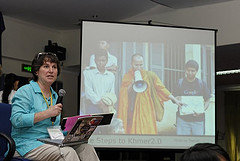
    Here’s a presentation Kristin Johnson and I did for the Social Media for Government Conference (we focused on the journey of discovering tools that facilitate communication!) :

    Internally Facing

    1. Google Chat or AIM – many of us at NWF use Google Talk or AIM to chat with coworkers, we still pick up the phone when needed, but chat allows us to answer quick questions AND document what’s said so that it could be used as a reference later.

    2. Skype Chat – Skype was something we used more frequently a few years ago, but it’s a great way to create chat rooms that can be saved. Instead of conversations that are one on one (like in Google chat) we could hold greater discussions.

    3. Yammer – Yammer is our internal “Twitter”, that allows us to update people and coordinate messages we tweet and prioritize. We also use it to ask questions and circle back on social media thoughts or resource sharing.

    Externally Facing:

    4. Twitter – Staff chat and support one another on Twitter, helping spread the news of important things and staying up to date on current events.

    5. Facebook: Many staffers will also chat through Facebook chat as well as re-post updates that we see are interesting from our news feeds.

    (Figure: NWF’s internal chat, Yammer)

    We still have a long way to go when it comes to letting all of these tools talk to one another. There are new plugins and tools all the time. For example, Yammer can be integrated into your Outlook, Downloaded to your desktop or smart phone, and connected to your Google Talk. With all of these options (and you better believe I have all of them) — it can be hard to suggest what is the most useful because it differs for everyone. However, the import thing to know, is that the more we behave like bees, the happier I’ll BEE.

  • *Note:  An updated version of this post can be found on Wildlife Promise called 25+ Nature and Wildlife Mobile Apps.

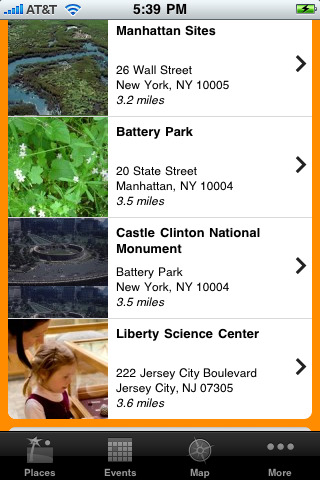
    If you managed to wrestle my iPhone away from me, you would see that I collect nature applications, everything from trail-tracking apps to apps that help me identify birds (my weakness).

    My goal is to find different ways for people to interact with nature using a mobile phone. Below I’ve written up a few of my favorites. I’d love to hear what apps you are using.

    Watching for  Wildlife

    WildObs Collection: I use the apps–especially WildObs Mobile and WildObs Lookup–on a regular basis. If you find yourself wanting to record wildlife sightings that include more than birds– it’s definitely my preferred app!

    Project Noah – Great application that also allows you to track your wildlife sightings! Definitely worth a download (it’s free!).

    Finding Nature


    NatureFind
    : Love this! (Disclosure–the National Wildlife Federation partners with both Naturefind and WildObs.) Search nature areas and outdoor events near you.

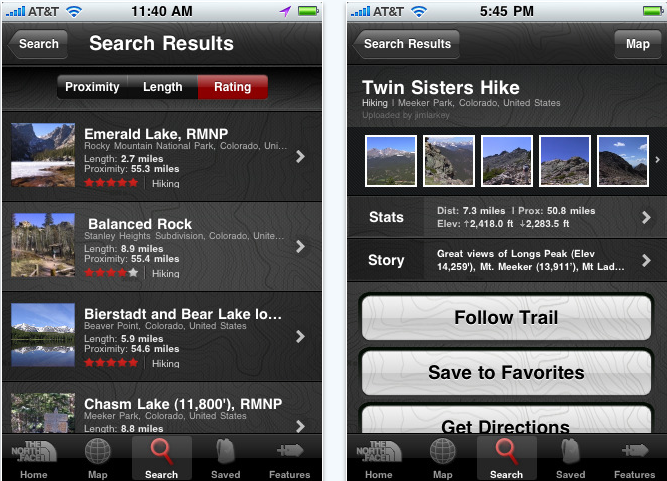
    The North Face Trailhead Application is a great (and FREE) application that lets you locate the trails near you. If you like to hike, or simply want to explore or photograph trails, this application can help you do just that.

    iBird Explorer Backyard: As an amateur bird explorer, this is a great app that helps you identify bird species and explore them by family, location and more.

    Fun with Plants

    Florafolio:  This app offers an interactive field guide to native plants of North America. This edition focuses on the stunning variety of trees, shrubs, perennials, ferns, vines, and grasses that are indigenous to Eastern Canada and North Eastern United States. Florafolio is the perfect guide for anyone who wants to identify species in the wild or garden with native plants.

    Botany Buddy: As a person looking to identify plants and exploring, I’ve truly found this app enjoyable. This app is useful when I know the name of what I’m looking for. You must have a profile, and it does require some basic understanding of plants. It  includes 4,500 full color photos and twenty-five key fields of information on each plant.

    I know there are countless I left out and I would LOVE to know your favorite nature apps! Share below and maybe I can review them!

  • A rabbit listens for predators
    Photo by Joshua Davis

    While animals are fun to listen to, they also tend to be fantastic listeners. Especially when they depend on their keen hearing to trap a meal or escape a predator.  When you look at creatures like bats, rabbits, foxes and so many others, you can’t help but marvel at how well they listen, and how their life depends on it.

    I feel very similarly about listening with social media. I truly believe you can’t survive the social media landscape for long without listening!

    Beth Kanter has written several fantastic posts about listening as an nonprofit organization any many of her articles point you to the right questions. For example, her post titled “Are you a listening organization?” not only shares great information about how to promote a listening culture internally, but it also discusses the 3 basic concepts for creating a structured listening strategy in your organization and making it a priority.

    Tools to Check Out For Listening:

    Google

    Search Comments and Forums:

    Blog and Social Media Search

    Searching Twitter

    Other Great Listening Tools

    • Postrank.com – and PostRank analytics – Tracks your blog posts with engagement measurement
    • Any RSS feed for your search terms!

    It’s important  to listen to your audience and the people you care about. The social web makes “listening” or politely stalking, as I like to call it– much easier! So check out these sites and make your own Google Dashboard or RSS feed and let me know how it goes 🙂 Then you’ll be listening like an animal!

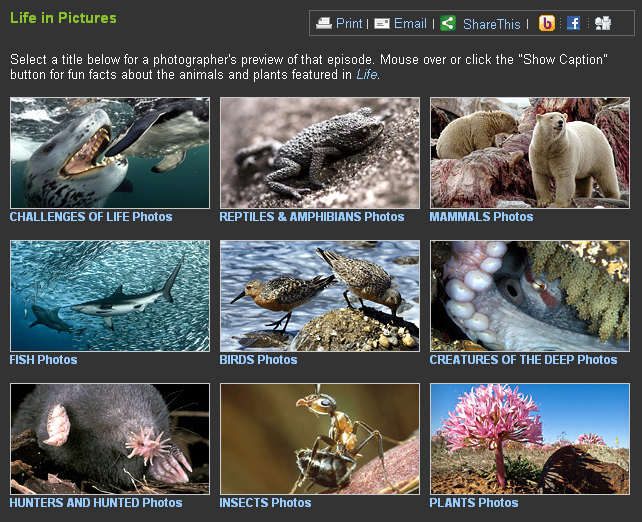
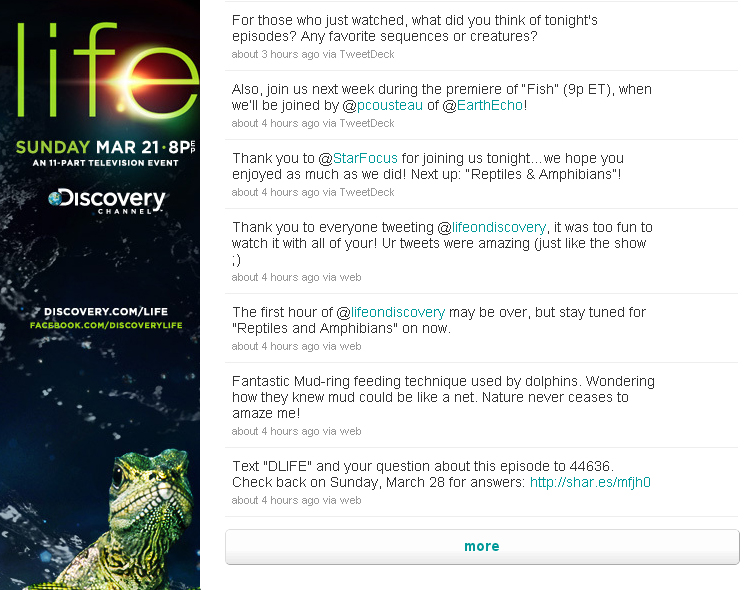
  • Yesterday was the premiere of Discovery Channel’s Life and I was honored to tweet from their account @lifeondiscovery through the first episode “The Challenges of Life”. It was an incredible experience! I loved knowing that there were thousands of people watching the show and marveling at the wonder of nature and wildlife. I also loved promoting the beautiful production, but most of all it was fun to watch so many people happily discussing nature on the twittersphere.


    In case you missed the first episode, the “Challenges of Life” spoke to the fact that in order to survive species must change and adapt to their surroundings. Here’s a breakdown of some of the animals the first episode covered:

    • Cheetahs: these speedy creatures can’t bring down a large animal on their own. But when they hunt together (you can watch the cheetah vs. the ostrich clip) they are much more likely to catch and take down large prey. You can even take the “Hunt Like a Cheetah” Quiz.
    • Panther Chameleon: their color changing capability isn’t the only thing that makes them cool, they also have strong tongues that catch insects from long distances!
    • Venus flytrap: This carnivorous plant uses sugary nectar to lure flies onto it’s trap, and if the fly touches two of the fine fibers within twenty seconds of each other the plant will close its leaves  rapidly.
    • Ibex: their skill at rock climbing and maneuvering steep ledges makes them hard prey to catch! Even a 10 day old ibex managed to out climb a red fox.
    • Sardines: they pack together to avoid predation– gives a new meaning to packed like sardines!
    • Flying fish: they move their tails 70 times a second and can glide up to 600 ft!
    • Crabeater Seal: they are said to be the second most numerous mammal on the planet (next to humans) and are very smart and quick!
    • Stalk-eyed Flies: they actually inflate their eye stalks to appear attractive to females. So flipping impressive

    There are many more animals discussed in the episode, but by far the most rewarding thing for me was to watch the twitter stream fill with people’s questions and reactions to the beautiful footage and the amazing facts introduced. It’s wonderful to witness people in awe of nature and with technology and social media, the whole experience becomes a social event.
    I absolutely loved what discovery did for showcasing the conversations on Facebook and Twitter. They were able to observe people commenting while also displaying their responses on the Life website.

    Here are 3 Reasons You Know The  Discovery Team Knows Their Social Media

    1). Guest twitter users on @lifeondiscovery account. Impressive way to engage people already active in the community. Especially people already interested in the topic (ahem me!:) )

    2.) Conversation Feeds that pull in from Facebook and Twitter. This is just awesome! While we haven’t figured out how to do this at the National Wildlife Federation, watching how Discovery did it for the Life premiere was impressive. Definitely gave me ideas for how to combine social conversations in one readable platform.

    3.) Connected with and following people who mentioned they were “watching Life” was not only smart social media use, but it got people to sites that they wanted, while also making them feel like they were part of something much bigger! The Life watching event trended worldwide on Twitter  for a majority of the first episode.

    In case you can’t tell, I’m impressed with the whole experience, but mostly I was just excited to connect with passionate people using technology– who care about…well of course… the natural world!

  • Recently, my one of my brave colleagues, Kelly Senser, ventured into the social media space despite her incredible workload.  She’s been a superstar ever since, and really provides value and friendship to anyone she meets.  If you don’t follow @klsnature and you love wildlife and gardening, you should.

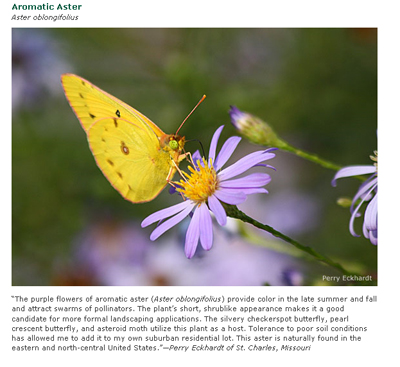
    She recently published an excellent article that reminded me of the importance of crowdsourcing. The article is  “Gardeners Pick their “Gold Medal” Favorites”. While the article was organized by Kelly, it has many authors. This way of collective knowledge is hardly a new concept, but it’s fantastic to see NWF working with sharp minds and talented gardeners to produce such a quality piece.  I’m certain we’ll see more articles like this in the future, but I just want to point out the excellent benefits of crowd-sourcing information.

    Each gardener was asked to pick a favorite plant that attracts wildlife to their garden. With each choice is a picture and a quote and includes the gardener’s name and blog! I highly recommend checking out this list. As someone who is still learning the ropes of wildlife gardening, it’s been so helpful to search on Twitter and find the conversation growing. (Heh). We’ve also created a Certified Habitat Wildlife Facebook fan page where I plan on asking all of my spring questions :).
    In terms of crowdsourcing, SEED magazine has one of my favorite articles on how science can use data and information collected through crowdsourcing and knowledge “pooling” . It’s fantastic to read about how the scientific community can communicate better with technology and house information  collected in various regions all over the world.

    There are a number of other examples of how nonprofits can use crowd-sourcing to learn more about their constituents and create a movement toward social change. Netsquared lets the community decide when it comes to challenge winners and idea submissions.

    Crowdsourcing for the sake of a contest or other means to garner a “viral” response does bring up more questions. Beth Kanter recently posted a thought-provoking piece called “Crowdsourcing Social Change: Who Gets to Vote?” where she questions some current crowdsourcing models and introduces a new contest model.
    It is my hope that we see more and more crowdsourcing when it comes to the scientific community and more strategic use of it when it comes to nonprofits who are trying to make social change. With great leaders like Kelly, gathering gardener’s minds for an excellent post on wildlife plants,  I say the sky’s the limit!


  • Yesterday I was able to attend the first Choose Clean Water Conference, put together by the amazing Chesapeake Bay Coalition. While I was lucky to be on Eric Eckl’s panel, I drew tremendous energy from the combined knowledge in the room. I came away from the discussion with several key points and a few ideas for concepts of future campaigns. Here are some great campaign tips even if you don’t choose water as your topic.

    For the BEST action based campaigns you should:

    1) Tell people what you expect them to do (First and Foremost) – no beating around the bush. Without a clear and concise message you lose them.

    2) Use stories to get your points across, facts are not as powerful as the story or feeling you leave with people.

    3) Make use of social capital – whenever you can– let people involve their personal networks and see others doing the action so that others see that your effort is legitimate.

    4) Focus less on the tools and more on the goals– It’s easy to get caught up in Facebook, Email and the many other mediums for which we reach people. It’s really best to finalize strategy before you think to the tactics.

    The Panel Discussion:

    Eric Eckl led the panel with his extensive understanding of what words work for water campaigns.

    And we were the panelists:

    We all were asked to rate water specific campaigns based on how strong we thought their words, pictures and the ask for action.

    I chose to review Healthy Lakes, Healthy Lives — an effort by the Healing Our Waters Coalition that focuses mainly on serving as a resource for legislative staff and caters to a more wonky crowd. I thought their call to action was incredibly strong but their imagery could be stronger. Still they won me over with their impressive Twitter and Flickr pages.

    I also rated The Bay vs. The Bag campaign put together by the Save the Bay people over in San Francisco. I loved the video– but felt like their call to action could have been much stronger.

    After we all presented, Eric broke people up into groups of 10 and they were asked to plan a campaign for Earth Day 2010. — Fantastic results! We had an incredibly creative audience.

    Overall– it was a blast seeing everyone’s campaigns and it was very difficult to judge the hard work.


    Image by Choose Clean Water

    Look through the Flickr stream to see some of the pictures from the panel.

  • While I’m busy at the awesome Choose Clean Water Conference I can’t let it slip by that it is Beth Kanter’s Birthday today. Beth has helped countless wildlife organizations spread their messages and learn how to use social media. She’s also a wildlife watcher herself and makes sure to take her kids outside. 🙂 She’s a very important figure in the Nonprofit community and I can’t mention enough how grateful I am that she was born and came into my life!

    If you haven’t taken a look at her blog you can find a plethora of tips and strategy insights. She’s definitely one of the brightest minds and network weavers I know. For her birthday she is generously asking people to support  The Sharing Foundation, so check out the cause if you get a chance.

  • There are a number of effective ways to monitor response with social media. Today I’m feeling inclined to talk about tracking Twitter hashtags.

    With NWF’s Wildlife Watch program we encourage people to #NWF every time they see wildlife, this in turn goes on our website.  It’s been a long-term campaign with random spikes in interest and observations.

    I’ve decided to talk about two of the tools that I’ve found most useful. While I used to rely primarily on hashtags.org that site seems to have fallen to the wayside by other sites that track more reliably and with interesting data.  Here are my two choices!

    What the Hashtag?!
    – this serves as a user’s editable encyclopedia for hashtags – so if you have a hashtag you want to track– this is one of my favorite options. Not only can you RSS the results– but it gives you helpful information such as how often the tag is used each day and it details who the top ten users are. This data is very helpful if you are tracking either an event or a long-term campaign!

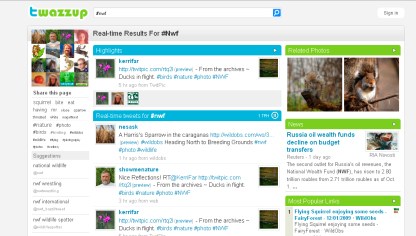
    Twazzup: This tool is more visual and helps me see the wildlife sightings in greater detail (it allows me to see twitpics and photos). It also links off to recent articles where NWF is mentioned. Overall– it’s a great visual representation of what #NWF is doing and even shows the large number of contributors over time (it tracks for more than a week– unlike WThashtag).

    While these are just two of the tools I use– they are by far my favorite. I’m interested to know what tools you couldn’t monitor without–

  • For the past several months,  NWF has been asking people to pledge to get themselves and their kids outside more.

    Part of the fun of my job was to ask parents and activists to take the pledge. Not being entirely certain that the original pledge would work for social media’s sake– I created both one on Facebook and one on Change.org. (We will compile the results from both of those when we’re done). Until then however, I’m simply gathering responses as to why people are even getting outside!

    Earlier I had asked people on Twitter What their Biggest Barrier was to getting outside.

    Many answers fell under the same basic categories:

    Time

    Health Reasons

    Company

    And of course, Weather!

    What are your barriers for getting outside?

    Sign the Be Out There Pledge!

  • I am not your typical human. I tend to love animals that people cringe at.  Spiders are a good example — I don’t cower in fear– I’m excited to come across them.  This presentation demonstrates what network weavers do, while also displaying a bunch of pretty spider photos!